
The historic climate change advisory opinion from the International Court of Justice suggests the United States is violating international law on climate, legal experts say.
By Dana Drugmand – https://insideclimatenews.org/
Una May Gordon, Jamaica’s former principal director of climate change, noted on opening day of the United Nations climate summit last week in Brazil that her country had recently suffered “catastrophic loss and damage” in the wake of Hurricane Melissa.
“We just need some accountability for those who are definitely responsible for this crisis,” Gordon said, calling for an end to impunity for major greenhouse gas emitting countries.
Climate justice advocates have been demanding this for years, always with science on their side. Now they say the law is, too.
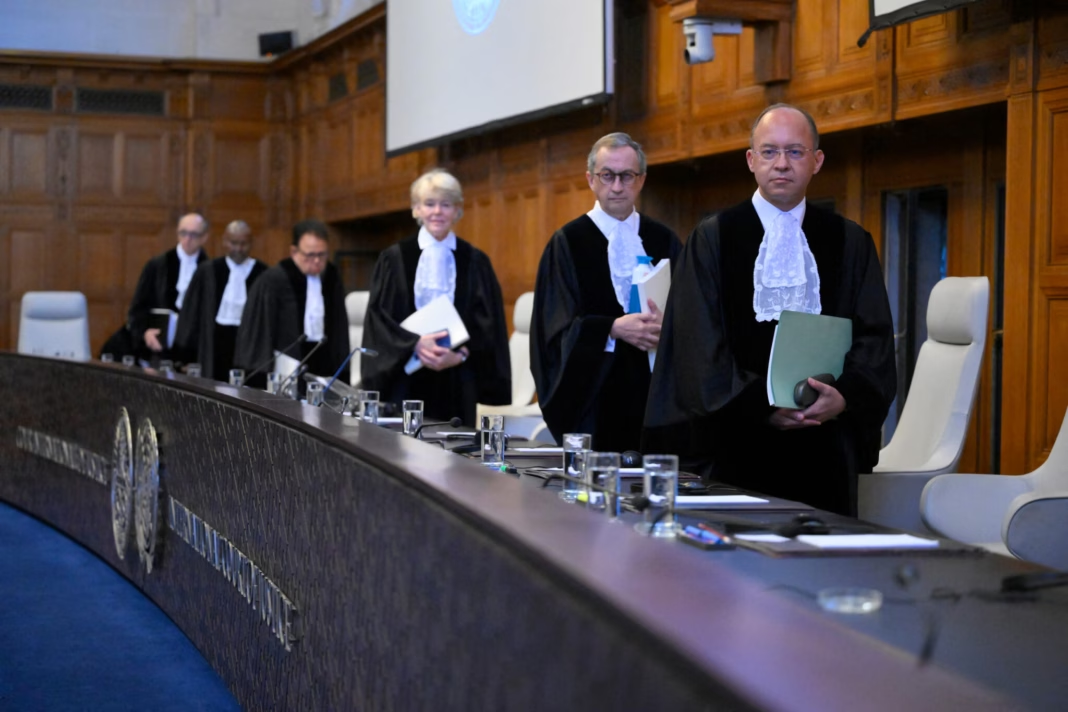
For the first time in the 30-year history of the U.N. climate talks, this year’s negotiations in Belém are happening against the backdrop of a recent landmark ruling from the International Court of Justice—the world’s highest court—clarifying what countries must do to confront the climate crisis under international law, and what the legal consequences are for failing in their responsibilities. In doing so, the Court has turned what many governments treated as political choices into enforceable duties.
In its unanimous, historic advisory opinion delivered in July, the court recognized that the climate crisis is an “existential problem of planetary proportions” and that taking action to mitigate and adapt to it is not optional, but a requirement under multiple sources of international law. The court also found that U.N. member states can be held liable for breaches of their legal obligations to protect the climate system.
Countries like Vanuatu, the small Pacific island state that led the initiative to seek a climate change advisory opinion from the ICJ, are hopeful that the court’s declaration can serve as a turning point in catalyzing more ambitious climate action and infusing more accountability into global climate diplomacy.
“We hope that by the time we get to Belém, this advisory opinion will have permeated through the understanding of everybody who’s at those negotiations,” Ralph Regenvanu, Vanuatu’s minister for climate change and the environment, said on a July panel following the court’s ruling.
While most major emitters are present at Belém, the United States notably is not. It is the first time that the U.S. has not sent an official delegation to the COP—the Conference of the Parties, or 197 nations that agreed to the United Nations Framework Convention on Climate Change in 1992.
Even during Donald Trump’s first term, the world’s largest historical carbon polluter had a presence at the negotiations. Some observers including former UNFCCC executive secretary Christiana Figueres have suggested the U.S. absence might be a good thing, given the current administration’s firm position of climate denial and outright hostility to climate action.
But absence does not mean the U.S. should be ignored or is somehow absolved from its legal obligations, climate law experts say.
“Whether the U.S. is at the COP or not, its impacts are ever-present and demand accountability,” Nikki Reisch, director of the climate and energy program at the Center for International Environmental Law, told Inside Climate News. “The ICJ was very clear. It didn’t cite countries by name. But its message to the United States was unmistakable—that all countries have a duty to prevent climate harm and protect human rights from the impacts of climate change, regardless of whether they are parties to the climate treaties or not. Withdrawing from the Paris Agreement does not absolve the U.S. of its climate obligations.”
In an emailed statement, a State Department spokesperson defended the Trump administration’s action to exit the Paris Agreement, referring to it as a “scam” under which the U.S. would be “expected to contribute far more financially than any other country.”
Advisory opinions, while technically nonbinding, are considered authoritative interpretations of existing law that is binding. And as the principal judicial body of the United Nations, the International Court of Justice brings significant weight and importance to its opinions.
“Withdrawing from the Paris Agreement does not absolve the U.S. of its climate obligations.”— Nikki Reisch, Center for International Environmental Law
“The U.S., as long as it is part of the UN, is supposed to follow this advice,” Margaretha Wewerinke-Singh, an international lawyer who served as co-counsel for Vanuatu during the ICJ proceedings, said at a press briefing following the ICJ’s issuance of its opinion. “It is as much bound by this advice as other states are.”
The court’s opinion came on the heels of another historic climate change advisory opinion handed down by the Inter-American Court of Human Rights on July 3, which recognized the right to a healthy climate for the first time at the international level.
The International Tribunal for the Law of the Sea also delivered an advisory opinion in May 2024 concluding that states have legal duties to curb greenhouse gas emissions, which constitute pollution of the marine environment. Collectively, these opinions establish that climate action is a legal obligation, the climate law experts say.
But the Trump administration is going above and beyond in the opposite direction. It is doubling down on fossil fuels—the primary driver of greenhouse gas emissions—while dismantling climate and environmental policies, undermining renewable energy, and suppressing climate science. Media reports that the Environmental Protection Agency was about to release its official proposal for repealing its greenhouse gas endangerment finding came out on the very same day as the ICJ’s climate advisory opinion. EPA then issued its rollback proposal on July 29, just days after the world court warned that failure to regulate climate pollution could be deemed unlawful.
What the U.S. government is doing on climate and energy under the Trump administration contravenes not just the science, but also multiple treaties the U.S. government has bound itself to, experts say.
Maria Antonia Tigre, director of global climate change litigation at Columbia University’s Sabin Center for Climate Change Law, told Inside Climate News that the ICJ’s opinion “suggests that the U.S, as one of the largest historical and current greenhouse gas emitters, is very likely in breach of its international obligations—including under customary international law and human rights law—to prevent significant climate harm and to protect the rights of present and future generations.” The court’s opinion, she said, is “far from symbolic” and carries “significant legal and normative weight.”
Reisch said the U.S. is “unquestionably violating international law on climate in multiple ways.”
“The U.S. continues to breach its legal duties to use all means at its disposal to prevent climate destruction through its failure to rein in and phase out fossil fuel pollution, its failure to provide climate finance at scale to developing countries, or to remedy the mounting harms for which it bears outsized historical responsibility,” Reisch told Inside Climate News. “But it’s also violating international law through the reckless expansion of fossil fuels in the midst of a raging climate emergency.”
In one of its most striking statements, the ICJ suggested in its advisory opinion that countries that continue to prop up the fossil fuel industry could be in breach of their legal obligations.
“Failure of a State to take appropriate action to protect the climate system from greenhouse gas emissions—including through fossil fuel production, fossil fuel consumption, the granting of fossil fuel exploration licenses or the provision of fossil fuel subsidies—may constitute an internationally wrongful act which is attributable to that State,” the opinion asserts.
By those standards, the United States, currently the world’s top oil and gas producer, appears to be committing internationally wrongful acts. Reisch pointed to the Trump administration’s reported plans to expand offshore oil and gas drilling including off the California coast as just one of the latest displays of its “flagrant disregard both for climate reality and for legal duties.”
The White House did not immediately respond to a request for comment.
Full article can be found on here.