

- The Carbon Market Bill passed its second and third readings and now moves to the Senate.
- It is a framework bill, with key regulations to come later.
- Concerns were raised about unclear carbon credit ownership and low penalties.
- Government will seek World Bank and Taiwan support to develop the required systems.
By Marco Lopez
On November 20, 2025, the Climate Change and Carbon Market Initiative Bill, 2025, was read for the second and third time in the House of Representatives. The bill now moves to the Senate for final approval before it is enacted and gazetted as law.
According to a release issued by the Ministry of Sustainable Development, Climate Change and Solid Waste Management today, once enacted, the bill will “enhance national planning, improve access to climate finance, and support data-driven climate action.”
The release states that the bill offers important safeguards for communities and landholders who may engage in future climate-related activities. But those “safeguards” are not completely spelled out in this new piece of legislation, Minister Orlando Habet explained during the lower house sitting.
Leader of the Opposition, Tracy Taeger Panton, raised that the issue of ownership of the carbon credits has not been sufficiently taken into consideration, pointing out remaining “confusion” over who owns the carbon credits and has the right to sell them.
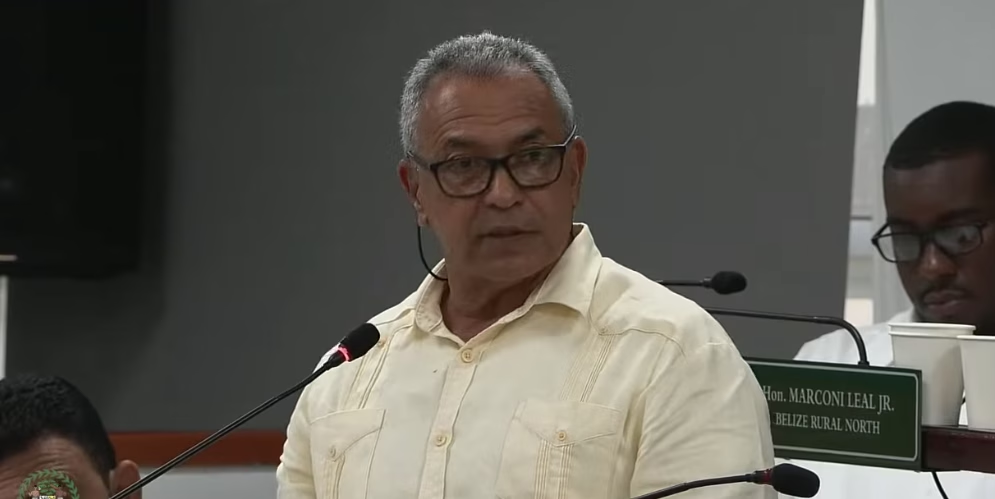
“The way the bill is staged, it is a framework bill,” Minister Habet said in response. “And so you don’t have all the details within the framework bill, because the framework bill is just what it says. After the bill, now, we will come up with the regulations.”
He said that stakeholders wanted to see the benefit-sharing mechanism outlined within the bill.
“So what we did, we put in a paragraph to explain what the benefit-sharing mechanism will be, but the actual benefit-sharing regulation, an entire regulation, will come in afterwards,” he said.
Panton also raised concerns about the penalty legislated for infractions in the new bill, pointing out that it may be too low considering the projected value of the carbon market.
“We feel certainly that those penalties — I think $20,000 is the cap — are far too low when we are looking at an industry or a market that measures in the millions and millions of dollars. So I don’t know that $20,000 is a deterrent,” Panton said.
Habet agreed that the cap for the penalties might be too low, but said those rules are for actors who may try to engage in carbon market projects without authorization and lie about their activities.
“Anybody that wants to have a carbon project will have to apply to the registry and say, well, I have this carbon project I am developing where I’m planting trees or I’m planting mangrove, or I have a project to trap carbon dioxide or reduce emissions — those are all carbon projects,” Habet said.
Panton asked whether the registry would be open to the public, to which Minister Habet said yes, adding that the Chief Climate Officer would be its registrar.
Today’s release from the ministry states that the new bill “represents a major step in reinforcing Belize’s national climate governance system. It establishes the institutions and systems needed to plan, implement, coordinate, and track national climate action.”
“It offers important safeguards for communities and landholders who may engage in future climate-related activities and sets national rules that benefit youth, civil society, Indigenous Peoples, and the private sector,” the release states.
But maybe not at its passing.
Minister Habet shared that support from the World Bank and partners like Taiwan would be drawn upon to help create these systems intended by the new bill.
“At the COP in Brazil, we had a meeting with the World Bank, we had some consultations with the people from Taiwan and other institutions who are willing to assist us to come up with the regulations and the standards and the policy, so we have assistance coming up for that already,” Habet said.