
Belize became the first Caribbean country to ratify the agreement, helping push the historic ocean governance treaty into force.
By Climate Spotlight
The first legally binding treaty covering international ocean zones came into force on January 17, 2026. The purpose of the Biodiversity Beyond National Jurisdiction agreement, also called the “ocean” or “high seas” treaty, is to ensure that the high seas and the international seabed are managed sustainably for the benefit of all humanity.
This is the first legally binding treaty governing international ocean areas — it’s a big deal — with an even greater hurdle ahead: implementation.
Belize was one of the first countries to ratify the agreement in April 2024. The country’s signing helped rally momentum toward the 60 ratifications required for the treaty to enter into force. On September 19, 2025, the required 60 ratifications were confirmed.
Why is protecting the ocean important to fighting climate change?
Protecting the ocean protects the planet’s climate system.
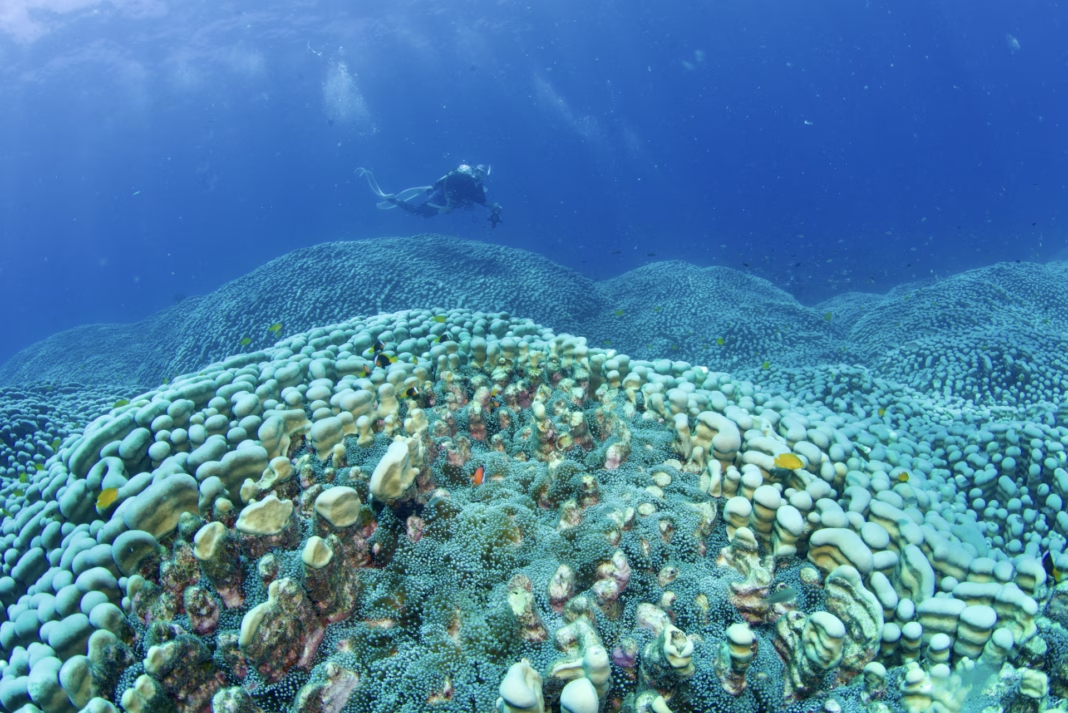
The ocean regulates the planet’s climate, absorbs large amounts of carbon dioxide, and supports ecosystems across the planet. Healthy marine ecosystems act as natural carbon sinks, like old trees, storing carbon for long periods. This is referred to as blue carbon.
When our oceans are not protected and ecosystems are overfished, polluted, and destroyed, their capacity to store carbon and regulate climate weakens. The high seas are particularly vulnerable to deep-sea mining — a highly destructive practice that has the potential to topple ancient ecosystems in a single extraction project.
This new treaty is important because it addresses major gaps in ocean governance. These waters beyond national jurisdiction cover about two-thirds of the ocean. Until now, there has been no comprehensive international mechanism to create large-scale protected areas there.
Protecting and sustainably using ocean areas beyond national jurisdiction is at the core of the agreement. Countries that ratify the treaty are legally bound to support the conservation and sustainable management of high-seas biodiversity.
Kinks, however, still need to be ironed out, including details on implementation procedures. These are expected to be finalized at the treaty’s first summit within the next year. The first BBNJ COP will cover critical issues such as the designation of high seas marine protected areas and how the environmental impact of ocean activities beyond national jurisdiction should be assessed, among others.
This treaty has been in the making for 20 years, making it a major win for ocean advocates, governments, organizations, and all others who worked toward securing it.
For Belize, the treaty represents more than a diplomatic milestone. As the first Caribbean country to ratify the agreement, Belize helped signal regional commitment to protecting the global ocean. The country’s leadership reflects its long-standing role in marine conservation and recognizes that healthy oceans are vital for climate resilience, fisheries, tourism, and the livelihoods of coastal communities.
In many ways, protecting the high seas protects the future of coastal nations like Belize.