

New Challenges and Increased Risks at Sea
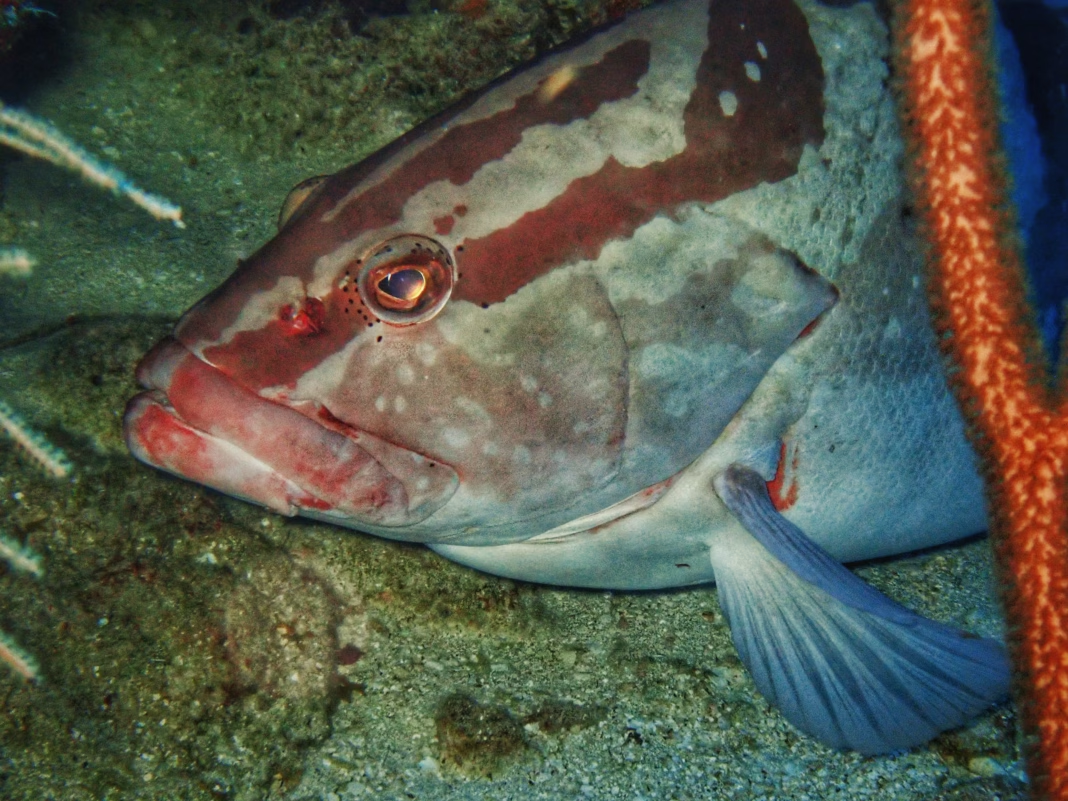
In the course of their work, rangers have used a variety of tools to stop and prevent violations under their management. These items include knives, GPS systems, and compasses for navigation, and measuring tools to ensure that harvested product (lobster, conch, and Nassau grouper) meet the legislated size minimums.
More recently, these traditional tools have been supplemented by a variety of digital monitoring and surveillance technologies. The most commonly used across co-managers is the SMART system, an application that was first rolled out in Belize in 2015. Cowo of SEA stated SMART “records the amount of fuel and distance covered” and allows her to “see the rangers’ observations and upload the evidence.”

With the passing of the Blue Bond and the unlocked conservation funds, some co-managers have allocated a portion toward expanding their surveillance technologies.
In the case of SEA, they used the Belize Fund’s Grants Award Program (GAP) funds to purchase and install a camera tower at Laughing Bird Caye. This device, equipped with a 360-degree view of the island and surrounding waters as well as night vision capabilities, is now monitored by rangers whenever at the station.
Commenting on its use, SEA enforcement officer Marlon Chun stated, “It’s just like we are patrolling. When we are not doing patrols, we would have someone checking on the cameras to see.” Cowo says that the camera has allowed for immediate detection of users in the area, allowing rangers to conserve precious fuel in their patrol efforts and also providing recording capabilities that help them to identify possible culprits.
Within the government, changes in enforcement have also happened as a result of the Blue Bond and the rising cost of fuel. Along with five other government agencies, the Belize Coast Guard (BCG) received funds from the Belize Fund’s first round of Government Strategic Allocations. The Blue Bond and Finance Permanence Unit (BBFP) within the Office of the Prime Minister, according to the Belize Fund’s Program Manager Josue Oliva, “is the only unit within the government that can access funding directly.”
Between 2023 and 2024, BCG used its BZD $1 million allocation to support the acquisition of 4 drones from U.S. manufacturer Skyfront. BCG also sent 6 Coast Guard members to train in San Francisco with Skyfront staff in drone piloting and maintenance.
One of those trained in piloting and maintaining the drones was Lieutenant Emerson Garrido, who serves as BCG’s Drone Squadron Commander and is a graduate of Heroica Escuela Naval Militar in Mexico, where he received a degree in Naval System Engineering.

According to Garrido and the GSA proposal submitted by the BBFP, the drones were acquired as an “innovative way for us to fulfill our conservation enforcement mandates.” As opposed to requiring 200 gallons of fuel per patrol, Garrido states that the drones can complete the same patrol route with 5 gallons, with an average flight time of five hours per trip.
Garrido estimates that since the squadron began operations, they have patrolled 30% of the country’s marine environment, deploying from forward operating bases on Calabash and Hunting Caye, as well as the BCG HQ in Belize City. Garrido views the drones as the BCG’s “eye in the sky that ensures that the protected areas are always monitored.”
The Push for International Collaboration
“Those who are caught are in between three hammers instead of just between a hammer and an anvil.”
Even with all the additional tools for enforcement patrols, Tunde of WIO-COMPAS stated that enforcing expanded MPAs is no longer only about patrolling, but negotiating with other sectors.
Tunde stated, “Enforcement of MPAs will be about addressing conflicts and land planning.” For instance, as rangers in transboundary areas further their patrols near the national borders of Honduras and Guatemala, their encounters with fishers not previously met will increase.
In response, there has been a more concerted effort to expand collaboration with Guatemala and Honduras in their enforcement activities. As SEA’s Wilbur Garbutt put it, “Those who are caught are in between three hammers instead of just between a hammer and an anvil,” referring to regional efforts to disincentivize unsanctioned transboundary fishing.
The Trinational Alliance for Conservation of the Gulf of Honduras, or TRIGOH, is one regional effort aimed at improving enforcement across the Gulf of Honduras. However, Garbutt alleges tensions remain due to Honduras and Guatemala’s respective claims on parts of Belize’s territory, including the Sapodilla Cayes, which are reserved areas. To support TRIGOH’s efforts, The Belize Fund’s Executive Director Leandra Cho-Ricketts stated that “Funding goes to them to support various meetings in Guatemala and Honduras with their partners as well as some awareness training and some capacity building for those communities.”

Map generated with information from the Coastal Zone Management Authority, the government agency developing the Integrated Coastal Zone Management Plan (ICZMP) as part of milestone 5.
In addition, TIDE’s Chavarria states that fisheries laws are not harmonized regionally. “For example, if I caught you with a turtle in Belize, I might charge you BZD $2,000, plus you could get prison time. In Guatemala, you get charged like 500 quetzals [=131.26 BZD] and there’s nothing else. So people from Guatemala don’t care. They’ll come and overexploit whatever you have.”
Transboundary issues are also prevalent due to differences in how rangers and fishers access protected areas. Wilbur Garbutt shared that crossing the reef to return to Little Water Caye can prove extremely dangerous, while fishers coming from Honduras don’t need to cross the reef to return to the mainland and are more willing to take the risks of navigating hazardous sea conditions. Therefore, Garbutt stated, “Before I send a captain out there in the night at certain times of year, I’d prefer that the fishers come and take the spoils. The safety of our rangers and vessels comes first.”
Even so, despite the threat of transboundary fishing, local illegal fishing remains the prevailing concern. In Chavarria’s view, “We can’t just blame it on the Guatemalans and Hondurans all the time because it’s not completely true. It’s scapegoating.”
“Before I send a captain out there in the night at certain times of year, I’d prefer that the fishers come and take the spoils. The safety of our rangers and vessels comes first.”
At Port Honduras, for instance, TIDE has observed a rise in the use of fish pots by locals since the COVID-19 pandemic. Chavarria stated that a single fisher can have hundreds of fish pots that they deploy and check for fish when able. In the interim, Chavarria alleges that up to 80% of the fish die in the pot, wasting fish product.
Continue to the final page, learn how effective Belize’s MPA Strategy has been so far, and just how much Belize’s Marine Protected Areas co-managers are receiving to meet their enforcement needs.