

Measuring Efficacy of MPA Strategy
With all the effort put into enforcing Belize’s MPAs, the question remains how effective they’ve been at mitigating unsanctioned activities within the various zones and promoting biodiversity. In Chavarria’s view, “we are far below” the enforcement needs of the MPA expansions. Asked how they could better meet the challenges of enforcement, all MPA managers expressed a desire for more funds to hire more rangers and purchase more vessels.
One way Chavarria suggests this can be done is through an increase in park fees. “Right now, the user fees are like 10 US per person. Imagine that. Which protected area would you go to in any other country for so little, enjoying that type of beauty? We could double that.” That solution may come to fruition as, in late October, the BBFP released a request for proposals on the same topic.
As for the performance of Belize’s MPAs so far as a biodiversity measure, a 2017 peer-reviewed study used a comparative analysis of reef sites at 8 marine protected areas and 8 unprotected sites. According to the results of that study, “fisheries restrictions alone do not lead to increases in coral cover even when successful for fishes.”
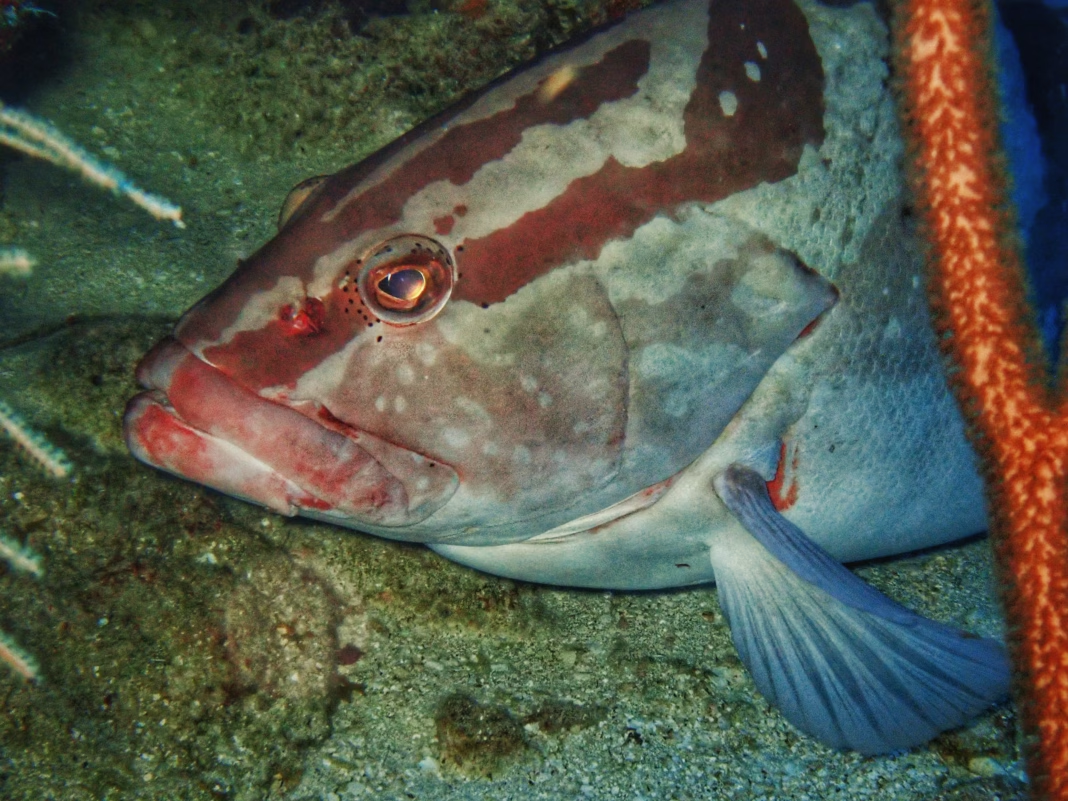
A more recent study published earlier this year on the Nassau Grouper indicated that, despite the protections provided to the fishing spawning aggregation site at Glovers Reef Marine Reserve, the Nassau Grouper remains at risk of complete eradication at the site should current trends continue.
Reflecting on the study’s results, lead author and former research coordinator at Wildlife Conservation Society Belize, Myles Phillips, stated that “there’s only so much that can be done by MPAs,” recognizing the efforts put into managing these sites by fisheries officers, fishers, and other stakeholders. Simultaneously, Philips cautioned against blaming fishers, stating, “It’s a big pet peeve of mine to blame fishers for everything happening in the marine space.”

Phillips added that in recent years, it’s become increasingly difficult for conservation organizations to source international funding, making long-term biodiversity projects difficult to sustain due to potential donors’ interest in results deliverable within a two to three-year funding cycle. Therefore, it’s more feasible for co-managers to conduct biodiversity research when they are able to partner with research groups. Friends of Swallow Caye (FSW), co-manager of Swallow Caye Wildlife Sanctuary, one of the smallest MPAs, is currently conducting bioacoustic research on the antillean manatees with the support of the Technical University of Catalonia’s Laboratory of Applied Bio-Acoustics (LAB). Through this partnership, FSW received hydrophones for deployment in the MPA and later sends the aggregated data to LAB to produce research that may help FSW better manage the site.

Maria Vega, one of the founders of Friends of Swallow Caye, shows a hydrophones regularly deployed at Swallow Caye Wildlife Sanctuary to conduct bioacoustics research on the Antillean manatee. 
Vega reviews the project proposal Technical University of Catalonia’s Laboratory of Applied Bio-Acoustics (LAB).
The Blue Bond’s Conservation Funding Agreement does not explicitly require that the government of Belize demonstrate improvements in biodiversity in its MPAs, with the Belize Fund’s ED Dr. Cho-Ricketts stating that “it’s through their management plans [developed as part of milestone 8] that managers would outline their monitoring programs, and their enforcement program to demonstrate site effectiveness.” Tunde of WIOMSA stated that “Without measurement or accountability, it’s just declaration,” and Muschamp at TIDE called the notion of expansion “a waste of time” if unsupported by any follow-up biodiversity studies.
Where the money goes—now and into the future
Efforts to support marine protected areas management can also be assessed by how The Belize Fund’s funds have been disbursed up to now. Most recently, MPA co-managers who are members of the Belize Marine Protected Areas Network (BMPAN) received an additional BZD $3,895,000.92 over 3 years (June 2024 – May 2027) to subsidize their operating costs, including ranger salaries.
That’s on top of BZD $559,563.00 BMPAN received in emergency gap funding in 2022 and BZD $2,628,386.34 awarded to individual MPA co-managers through the Grants Award Program’s first two funding cycles in support of their enforcement capacity, such as the 360-degree tower camera installed at SEA’s Laughing Bird Caye National Park or improving fisheries compliance at SACD’s Corozal Wildlife Sanctuary.
As an explanation for why MPA co-managers have received the most recent amount of approved grant funding, the Belize Fund’s Communications Officer, Chalsey Gill Anthony, stated in an email that “As Belize moves toward protecting 30% of its ocean space, enforcement has become a critical gap. Our 3-year partnership with BMPAN strengthens co-managers’ core operations and enforcement capacity—including drones, long-range cameras, and SMART systems—to ensure these areas are effectively managed.”As a result of these various efforts to support MPAs, co-managers have to date received BZD $7,082,949.67 of the BZD $26,324,312.77 approved for distribution, just over a ¼ of all funds distributed so far.

To view the data supporting this grant, click here. Any errors in computation are the sole responsibility of the article’s author. If you have any questions or corrections, please contact André Habet at hello@andrehabet.com, and he will gladly make the necessary corrections.
To address this difference in funding allocation, the Belize Fund is currently reviewing the fourth round of GAP proposals with a particular focus on assisting less-resourced registered organizations via Community Grants, albeit capped at BZD $50,000 per proposal. That’s BZD $25,000 less than the BZD $75,000 provided to community grant recipients like the Chunox Fishermen Association last year.
“The Belize Fund GAP is a “good program with good intentions. It just needs to be set up in a way that the real people who need it get access.”
During this latest funding cycle, the Belize Fund provided additional support to grant applicants whose concept papers were accepted. For those applicants, the Belize Fund held 5 webinars that Anthony wrote were intended “to provide more tailored guidance on the proposal development process.”
The Belize Fund is currently reviewing 6 community grant proposals, with a potential BZD $300,000 if all are awarded. Four were awarded during the last cycle. The Belize Fund will also provide community grant recipients with support in project implementation, monitoring, and reporting.
In past grant cycles, demonstrating capacity to complete these tasks—proposal development and project management—has created a hurdle for organizations that lack institutional capacity for work beyond their day-to-day survival activities. Reflecting on this issue, TIDE’s Chavarria stated that the Belize Fund GAP is a “good program with good intentions. It just needs to be set up in a way that the real people who need it get access.”
While the Belize Fund refines its funding allocation strategy, TIDE has recently established a small grants program, an initiative co-funded by the Belize Fund and the Mesoamerican Reef Fund. The program will support projects in the areas of “eco-friendly tourism ventures, small-scale agriculture, sustainable seafood processing, and alternative livelihoods.”
Providing up to BZD $8,000, TIDE intends to support fishers licensed for zones within the sites it co-manages, including the Port Honduras Marine Reserve, where a gillnet killed the hawksbill turtle and other marine animals mentioned at the opening of this story.
As Belize continues on its trajectory toward its next milestone this month in fulfillment of the Conservation Funding Agreement, it remains to be seen to what extent those outside MPA enforcement will receive the support necessary to secure their stake in the country’s marine space.
Additional reporting by Marco Lopez.
All photos by André Habet except where otherwise stated.
This story was published with support from Internews’ Earth Journalism Network.