

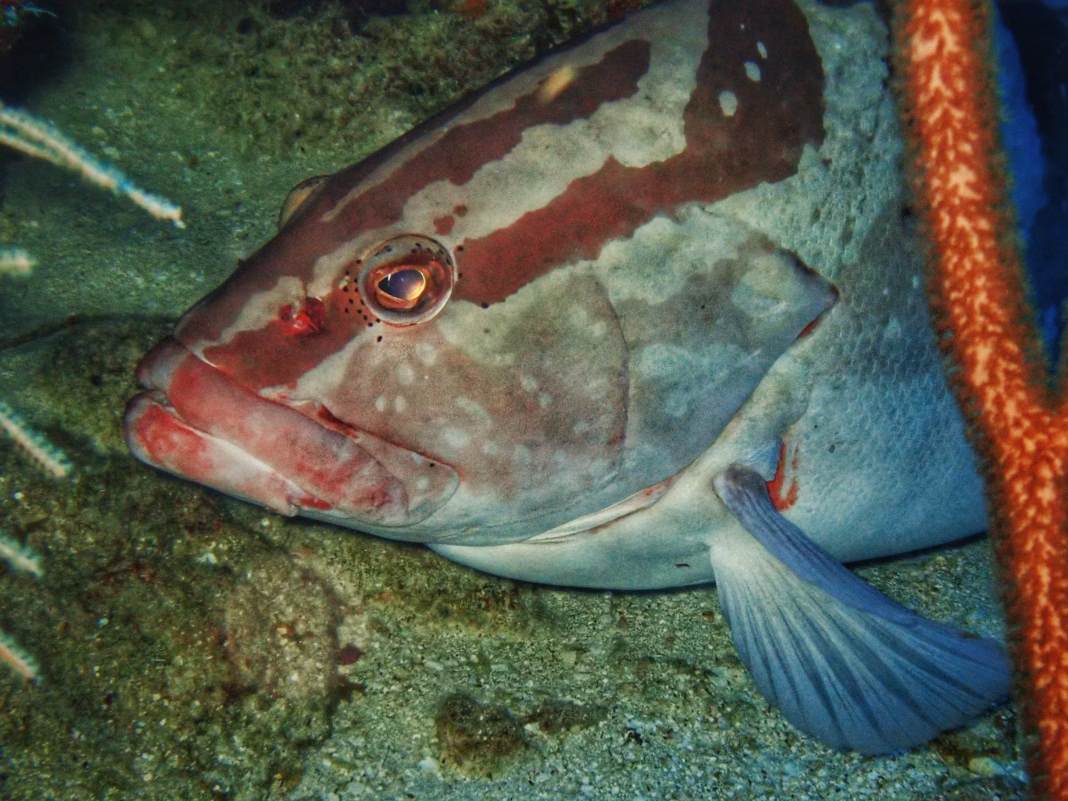
- The Nassau grouper (Epinephelus striatus), a large-bodied top predator, was once the most abundant and commercially important fish in the Caribbean.
- Each winter, the groupers gather en masse at special places to breed, but many of these so-called fish spawning aggregation sites have been dwindling or succumbing entirely to overfishing.
- A new study looked at an important spawning site at Northeast Point on Glover’s Reef Atoll in Belize and found that the number of Nassau groupers attending the annual gathering declined by 85% over the past two decades and is now “on a trajectory towards local extirpation.”
- It attributes the decline to the government’s limited capacity to enforce regulations aimed at protecting the groupers from fishing at the remote site.
By Marco Lopez
HOPKINS, Belize — The Nassau grouper is drawn by the winter moon, between December and March, to special places where hundreds of the cryptic fish engage in a reproductive dance that sometimes lasts days. Northeast Point at Glover’s Reef Atoll, off the coast of southern Belize, is one of those places.
The Nassau grouper (Epinephelus striatus) is a large-bodied, top-level predatory reef fish. Its pale tan to reddish-brown body with five dark vertical bars makes it easily recognizable. While these fish hide well, spending their days lounging in reef crevices and only emerging to feed at night, their highly predictable spawning aggregations make for an easy catch for opportunistic fishers. The species was once the most abundant and commercially important fish in the Caribbean. In Belize, fisheries records indicate that Nassau grouper was the most-caught fish during the 1960s, with estimated catches of more than 30,000 fish per year from a single aggregation site, Caye Glory.
Northeast Point is one of Belize’s 13 officially recognized fish spawning aggregation (FSA) sites for Nassau grouper. The aggregation there was also once an impressive sight, drawing an estimated 15,000 fish in 1975. Today, that moonlit annual gathering has all but vanished. The number of fish attending has declined by 85% over the past two decades and is now “on a trajectory towards local extirpation,” according to a recent study. It attributes the decline to the government’s limited capacity to enforce regulations aimed at protecting the groupers from fishing at this remote site.
“Since about the ’80s, the Belize Fisheries Department and scientists have been discussing ways in which they need to do something about the Nassau grouper situation,” Myles Phillips, a Ph.D. candidate at James Cook University in Australia who led the study, told Mongabay in an interview. “This didn’t start overnight.”
The study examines the status of the Nassau grouper population at Glover’s Reef Atoll, which is wholly encompassed by Glover’s Reef Marine Reserve (GRMR). The authors combined spawning counts, catch records and visual censuses taken between 2000 and 2023 to evaluate the population changes.

“Spawning aggregations of Nassau grouper back in the ’60s and ’70s on average used to have like 30,000 fish, and Caye Glory in particular used to have 100,000,” said Phillips, who was formerly a research coordinator at Glover’s Reef Atoll for the U.S.-based conservation group Wildlife Conservation Society. However, decades of intense fishing during the predictable aggregations have resulted in steep declines, the study noted, and the species is now critically endangered.
At the turn of the century, Northeast Point had around 3,000 groupers spawning, according to the study, making it one of two sites in Belize where more than 1,000 fish still gathered. A 2001 study estimated that the population at this site would “disappear” by 2013, but the aggregation survived.
According to Phillips, this is the result of measures enacted by the Belize Fisheries Department to protect the groupers. These measures, however, have not been sufficient to stop the decline altogether. In 2018 and 2020, only around 900 fish attended the annual reproductive gathering. By 2023, the latest year included in the latest study, just 463 individuals were recorded — a 97% drop since 1975.
Northeast Point’s seclusion contributed to the decline, reducing outside recruitment of new fish. It sits far from other reefs in Belize, and the atoll is surrounded by waters some 300-1,000 meters (about 1,000-3,300 feet) deep, which Nassau groupers can’t easily cross since they prefer to stick to the reef. Tagging studies have helped show the fish that spawn at the Northeast Point FSA also use the territory as their home ground and don’t typically migrate off site, according to Phillips.

By contrast, he said, the Caye Glory aggregation was so large because the site is connected to the Mesoamerican Barrier Reef, which extends 1,000 kilometers (620 miles) between Mexico to the north and Honduras to the south, giving fish from far away a clear path to reach the spawning site.
In an email interview with Mongabay, Alicia Eck-Nunez, a fisheries officer at the Belize Fisheries Department, said that due to the rough waters and difficulty accessing the Northeast Point FSA, the department has deployed hydrophones to help monitor spawning based on the sounds the fish make.
“Once processed, these data will provide valuable insights into fish behaviour and can identify timing, intensity, and duration of spawning events at the site,” she said. However, she added that there’s currently “no in-house capacity” to do this analysis.
Strict management measures exist to protect Nassau groupers at the Northeast Point FSA from overfishing, but inadequate enforcement is what’s mainly driving the decline, according to the study.

Phillips said illegal transboundary fishing contributes to overfishing. “The location is so close to Honduras, it’s easy for them to get there undetected, and it’s convenient; they can see the enforcement agents coming. We have gone out to the site and seen boats dropping gear, dropping fish, all kinds of things, and heading out,” he said, describing how fishers jettison evidence of their illegal activity as they try to avoid arrest. “And every year we would go diving at the site, we would see new fishing lines, new hooks, new anchors discarded at the bottom.”
He noted that the tumultuous waters near the FSA make enforcement difficult and costly.
While there’s a nationwide closed season from Dec. 1 to March 31 for Nassau grouper, fishing is always closed at Glover’s Reef — in theory at least. That’s because in 2009, the Belize Fisheries Department made a “gentleman’s agreement” with the fishers of the GRMR, according to Eck-Nunez. The fishers agreed not to catch Nassau groupers year round, and in exchange, the department let them dive for conch and lobster within the atoll.
The agreement still stands, but not all fisherfolk comply, according to a local fisher Mongabay interviewed for this story, who asked to remain anonymous for fear of reprisal from colleagues and the fisheries department.
The fisher said both local and transboundary illegal fishing are major problems at the Northeast Point FSA, and enforcement has never been sufficient to stop it.
Local fishers can’t have spearguns within the atoll; if they’re caught with one, authorities assume they’re targeting Nassau groupers. Other regulations place a size limit of 20-30 inches (0.5-0.75 meters), a requirement for Nassau grouper to be landed whole, and a requirement for all fish fillets to be landed with a skin patch to allow identification.

“The fisheries department has been doing a lot. There is always more you can do, but being reasonable and realistic, they have done quite a lot to try to manage the species,” Phillips said.
Yet doing more appears to be the only way to give the groupers a chance. “Closure of management gaps, including chronic enforcement resource deficits, may not guarantee recovery, but has been a necessary precursor to recovery of other fish spawning aggregations in the Caribbean,” the study points out.
The Belize Fisheries Department declined to answer questions about its enforcement capacity and limitations at this and the country’s other Nassau grouper FSAs.
The paper noted that Nassau grouper FSAs have already been extirpated at other sites in Belize, including Rocky Point and Gladden Spit. But at the other 12 other extant FSAs where the species is protected in the country, populations have remained stable over the last 20 years, Phillips said, emphasizing that the fates of Belize’s FSAs have been varied. For example, the Sandbore Caye aggregation has been stable since 2000, he said. And the famously massive Caye Glory aggregation, thought to be extirpated in the early 2000s, has reappeared — though with only around 2,000 fish, it’s just a wisp of its former size.
The Belize Federation of Fishers, however, emphasized the long-term decline of Nassau grouper and failure of management to effectively protect the Northeast Point FSA, in a release responding to the new paper. “This is not just a biological crisis — it’s an institutional governance failure,” the release said. “Despite two decades of protective regulations, enforcement remains under-resourced, and illegal fishing continues unchecked.”
It called the survival of the spawning aggregation at Glover’s Reef “a matter of national and regional urgency.”

Banner image: A Nassau grouper. Image by Connor Holland/Ocean Image Bank.
Citations:
Phillips, M., Tewfik, A., & Burns-Perez, V. (2025). Impending extirpation of an isolated Nassau grouper (Epinephelus striatus) population at Glover’s Atoll, Belize, based on two decades of monitoring. Coral Reefs, 44(5), 1513-1533. doi:10.1007/s00338-025-02697-8
Sala, E., Ballesteros, E., & Starr, R. M. (2001). Rapid decline of Nassau grouper spawning aggregations in Belize: Fishery management and conservation needs. Fisheries, 26(10), 23-30. doi:10.1577/1548-8446(2001)0262.0.co;2
This article was first published by Mongabay.