

The Atlantic Meridional Overturning Circulation (AMOC) is significantly more likely to collapse than previously thought, a new study in Science Advances found.
By Climate Spotlight Staff
On April 15, the journal Science Advances published a study finding that the Atlantic Meridional Overturning Circulation (AMOC) could slow by 42 to 58 percent by 2100 — a level the authors say is almost certain to end in collapse of the critical ocean current.
The AMOC is a major part of the global climate system, bringing sun-warmed tropical water to Europe and the Arctic, where it cools and sinks to form a deep return current. Think of it as the ocean’s conveyor belt, regulating temperature, rainfall and sea levels across the entire Atlantic basin. The AMOC was already known to be at its weakest in 1,600 years as a result of the climate crisis, with warning signs of a tipping point first identified in 2021.
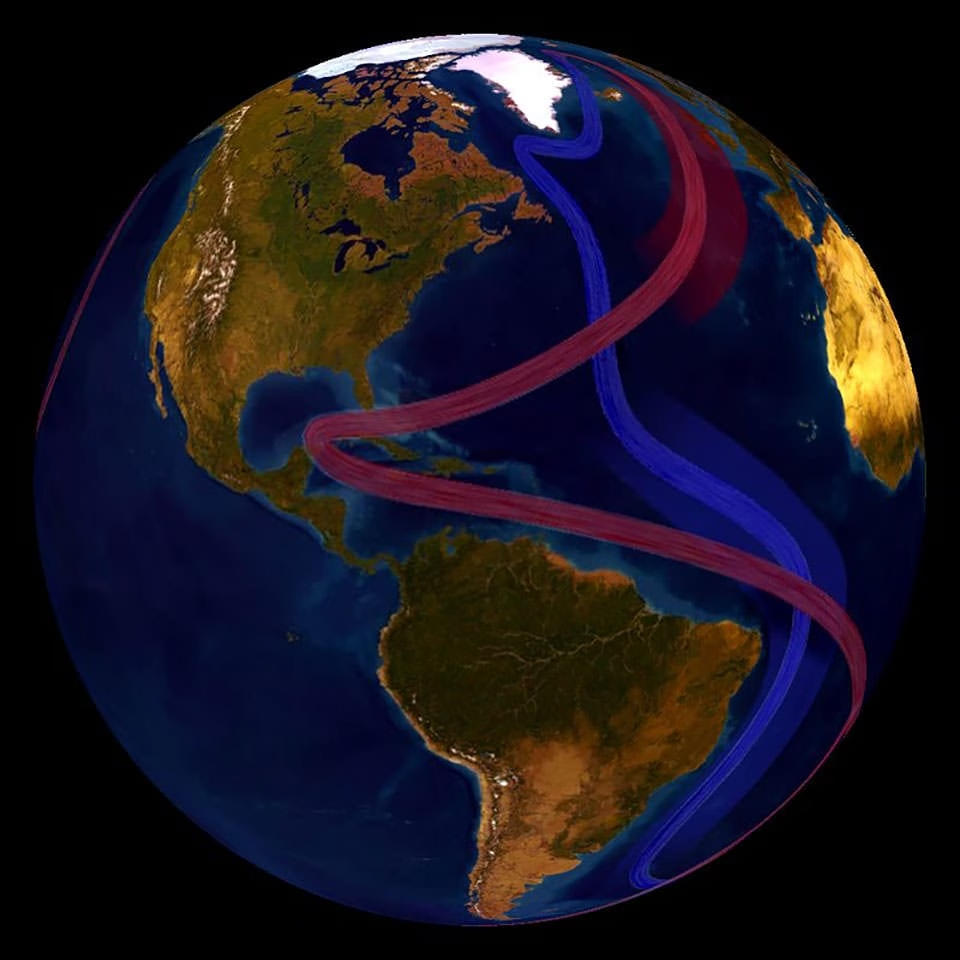
The study explains that warmer water is less dense and sinks more slowly — allowing more rainfall to accumulate in already salty surface waters, making them less dense still, and slowing the sinking further. This forms an AMOC feedback loop. A collapse would shift the tropical rainfall belt on which millions rely to grow food, and could push Europe into extreme cold winters and summer droughts.
Scientists say an AMOC collapse would cause global chaos. The last one occurred roughly 12,000 years ago.
The research combined real-world ocean observations with climate models to determine which models are most reliable, drastically reducing the range of uncertainty compared to previous findings. Earlier models produced widely varying results — from no further slowdown to a deceleration of up to 65 percent, even under net-zero scenarios. The new study narrows that gap by identifying the most observationally accurate models. Those models, it turns out, are the most pessimistic ones.
Lead author Dr. Valentin Portmann, of the Inria Centre de recherche Bordeaux Sud-Ouest in France, said, “We found that the AMOC is going to decline more than expected compared to the average of all climate models. This means we have an AMOC that is closer to a tipping point.”
Prof. Stefan Rahmstorf of the Potsdam Institute for Climate Impact Research in Germany, who has studied the AMOC for 35 years, called the findings “important and very concerning.”
He said the pessimistic models that show a strong weakening of the AMOC by 2100 “are, unfortunately, the realistic ones, in that they agree better with observational data.” Rahmstorf, who has long argued a collapse must be avoided “at all costs,” added that he is “increasingly worried that we may well pass that AMOC shutdown tipping point, where it becomes inevitable, in the middle of this century.”
He also offered a sobering caveat, outlining that the projected slowdown may still be an underestimate. The computer models used in the study do not account for meltwater from the Greenland ice cap, which is also freshening ocean waters and further reducing their density. In other words, even the most pessimistic projections in the study may prove optimistic.
Two tipping points, one cascade
To understand why scientists are so alarmed, it helps to understand what a climate tipping point is — and what happens when more than one tips at once.
A tipping point is a threshold in the climate system. Once crossed, it triggers a self-reinforcing change that becomes very difficult or impossible to stop, regardless of what humans do next.
The AMOC is one such tipping element. So is the Amazon rainforest. Both are considered among the most consequential in the Earth’s climate system, and both are under increasing stress.
A tipping cascade occurs when one tipping point triggers another. Scientists have grown increasingly concerned that the AMOC and the Amazon are not independent risks — they interact. Research has found that AMOC weakening changes sea surface temperatures in the tropical Atlantic, which in turn affects rainfall patterns over the Amazon.
A large-scale decline of the Amazon would mean the loss of the largest terrestrial carbon sink on Earth, releasing vast stores of carbon and dramatically accelerating global warming — which would, in turn, put further pressure on the AMOC.
The two systems are linked in the other direction as well. A recent study found that AMOC weakening has actually been increasing dry-season rainfall in parts of the southern Amazon, temporarily buffering some of the drying driven by deforestation and heat. But researchers caution that this interaction will not hold indefinitely. The Amazon is still drying overall, and no amount of AMOC-related buffering can compensate for the compounding pressures of rising temperatures and continued forest loss.
This is the broader context in which the new Science Advances findings land. A joint report published last week by the Food and Agriculture Organization (FAO) and the World Meteorological Organization (WMO) found that extreme heat is already severely impacting global food and farming systems. The AMOC findings suggest that the underlying climate architecture governing rainfall across the Americas — the rainfall that farmers, forests and food systems depend on — is more fragile than previously understood.
Scientists have a term for what happens when tipping elements begin to fall in sequence: a tipping cascade. Neither the AMOC nor the Amazon has fully tipped yet. But the direction of travel is clear, and this week’s research makes the margin for error look considerably smaller than it did before.